Try this for five minutes: simply observe, without deciding what anything means. You will discover something humbling. The mind cannot do it. A thought arrives and is instantly coated in judgment, before you even notice the coating happening. Someone is quiet, and within a heartbeat you have decided they are upset with you, or tired, or hiding something. The seeing and the interpreting arrive so close together that we mistake the second for the first, and live our whole lives inside our own commentary, believing it to be the world.
Marshall placed this at the very foundation of his teaching. Observation without evaluation. Not because judgment is wrong, but because when we mistake our judgments for facts, people hear criticism, and connection quietly ends before it began.
The Indian traditions gave this restless commentary a name: Chitta Vritti, the fluctuations of the mind. And they made a discovery that changes everything. Beneath the fluctuations, prior to them, there is something that was never fluctuating at all. They called it the Sakshi, the witness. Not a skill to be built. An awareness already present, watching the weather of thought and feeling without ever becoming the weather.
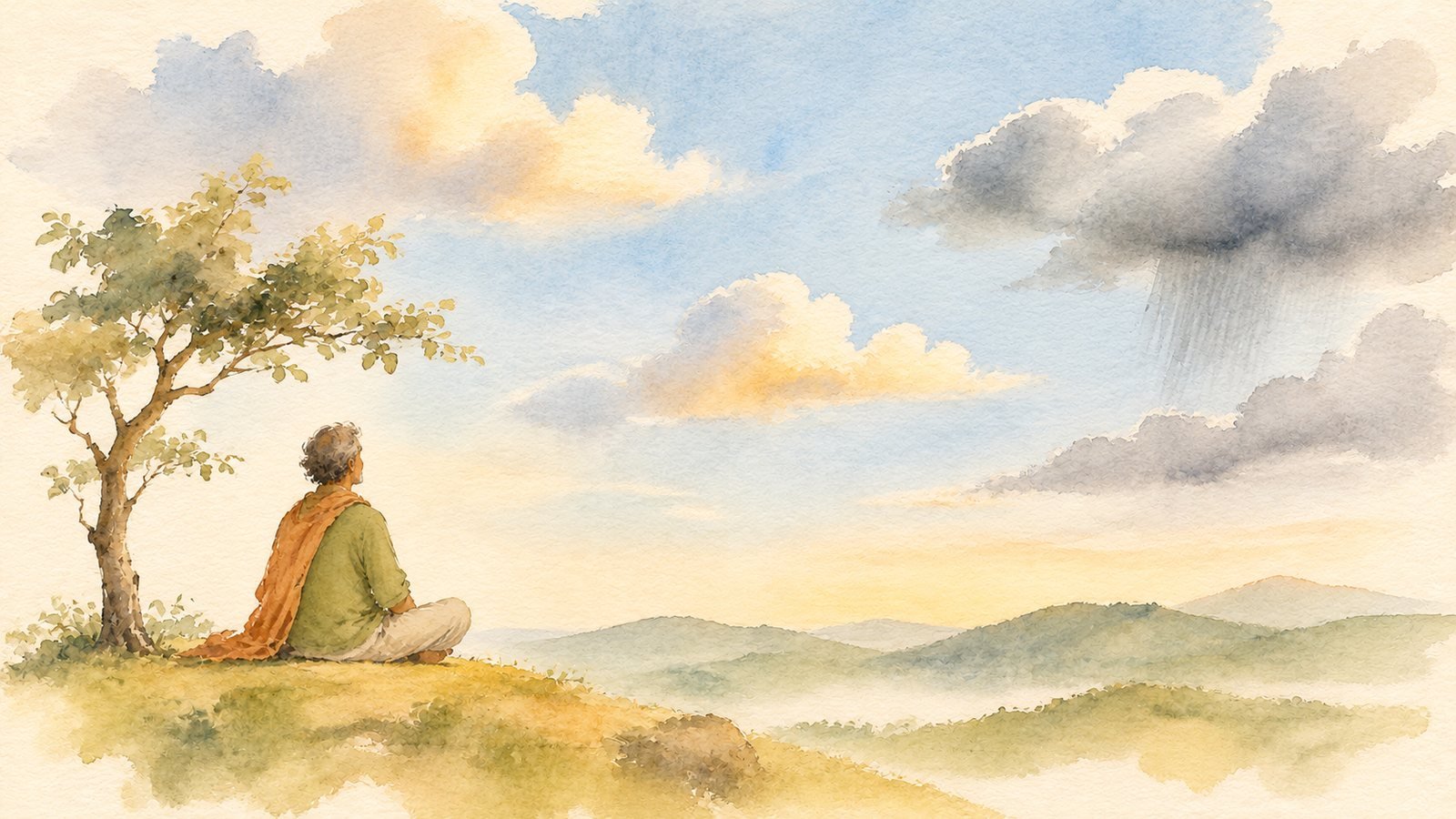
You are the sky, the tradition says. Not the cloud passing through it.
This is not detachment from life. It is the most intimate thing about you, so close that you normally look through it rather than at it. When you notice a strong reaction rising in a difficult conversation, and something in you quietly registers I am having a reaction rather than being fully consumed by it, that noticing is the Sakshi. A small gap opens between what happens and how you respond. In that gap lives nearly everything worth calling freedom.
The practice does not require years of study. Only the willingness, again and again, to step back half a breath and ask: what actually happened here, before I decided what it meant?
The sky was always clear.
We just kept mistaking the clouds for the whole of it.